Saturday, 6 September 2014

Top 5 Spring Walks in NSW

Top 5 Spring Walks in NSW

Season of snakes and small birds, spring in the NSW bush is rarely as spectacular as it can be in other parts of the world, but in some areas the bush tracks are festooned with flowers, and the amiable weather can suit short strolls or longer treks. It's a great time to be in the outdoors.

Here are five of my top recommendations for spring walking in this diverse state.

Waratahs aplenty near Pulpit Rock, Blue Mountains.

 1. Evans Lookout to Pulpit Rock, Blue Mountains
Virtually one continuous lookout along a spectacular clifftop, this 13km return walk provides stunning views of waterfalls, valleys, cliffs and one of the best opportunities to see NSW waratahs on a main track in the Blue Mountains. It undulates a little, but there are no large descents or ascents. The ending, Pulpit Rock, is surely one of the most underrated, dramatic features in the mountains. Access the walk via Evans Lookout Rd, Govetts Leap Rd or Pulpit Rock Rd.
The dramatic Pulpit Rock lookout.

2. Muogamarra Nature Reserve, Sydney
Usually only open for six weekends a year in spring, this wonderful refuge north of Hornsby has wildflowers galore (including NSW waratahs), Aboriginal engravings, lookouts and historic features. I've written a whole separate blog on this wonderful spot, which you can read here. If you're looking for something to do on a weekend in spring, I thoroughly recommend it.

3. Grand High Tops, Warrumbungles

Warrumbungle National Park. Amazing wildflowers in a dramatic volcanic landscape.
One of the most classic walks in NSW, through impressive volcanic country, this 16.5km loop walk was closed for some time after the devastatingly destructive fire of January 2013, but has recently reopened. Although the bush will take a long time to recover, there will be wildflowers out during the spring, and the views of features such as The Breadknife, Belougery Sprie, Crater Bluff and Bluff Mountains are some of the best in the state at any time of year.

4. Boomeri Camping Area to Shelley Beach Camping Area, Myall Lake

Best done as an overnight walk, this 25km return walk does involve a lot of slogging along a flat fire trail. But if you keep your eyes open, it will be a spring wonderland of wildflowers and wildlife, with birds galore, goannas, lizards, snakes and other surprises. The camping areas at Johnsons Beach and Shelley Beach are delightful, and worth hiking in for. Both on the shores of Myall Lake.

5. Light to Light Walk, Ben Boyd National Park

Ben Boyd National Park

I still believe this is the most spectacular coastline in NSW. It is right in the far south-east corner of the state, and this multi-day walk (probably best over 2 days) goes between two lighthouses, one of which you can stay in. The colours are extraordinary, from the orange and maroon rocks, to the turquoise and aqua water, and the wildlife is rich, with turtles, whales, wallabies, wombats and dolphins. It is relatively flat, easy walking, and there is a great camping area halfway, at Saltwater Creek. The worst thing is that the 32km walk currently has no organised transport to get back to the start, so you either need to do a long, long car shuffle, or walk both ways. Or you could just drive to Saltwater Creek, set up camp, and go for long day walks in each direction.

Full track notes and more information is provided on all these walks in my book, Top Walks in NSW. It's currently available for a bargain if you look around, and there's an e-version to download on your ipad.

See you on the track
www.kensbigbackyard.com.au

Sunday, 24 August 2014

Latest Glam Multi-day Walks in Australia

Latest Glam Multi-day Walks in Australia

Comparing two of the latest guided multi-day walking experiences in Australia 

Scenic Rim Trail, southern Queensland

Looking for something more than a day walk, but not sure you want the hassles of carrying a large pack and tent? Want to finish a day's walk with a hot shower, comfy bed and a glass of wine, not a packet of two-minute noodles and a thin mattress on the ground?
Great Walks of Australia has a growing list of Australia's best multi-day walking experiences, but with strict criteria to get on their list: there must be private accommodation along the way, an emphasis on quality food and wine, and walks must be guided by knowledgeable guides.
I've walked parts of nearly all the walks listed by Great Walks of Australia, and this year, through my work for various publications, I was blessed to enjoy two of the latest walking experiences on offer in the great walks group. Here's a little compare and contrast, in case you were considering either. Please note both trips were provided gratis to me.

Scenic Rim Trail
This is the newest and cheapest of the Great Walks of Australia - but don't be fooled into thinking this is a shonky operation. Established by the classy Spicer's brand, the highlight here is definitely the food and the accommodation. Much of the walk is on the company's own beef farm in south-east Queensland, wandering through forests, woodlands and up mountains, occasionally dipping into national park. There are some great views to be had, and some lovely ancient hoop pine forest. It's pleasant, but for the most part, the walking isn't what you'd call spectacular. It's at the other end of the Scenic Rim to the renowned Lamington National Park, which for my money offers more beautiful terrain in this part of the country.
The mid-year season means that the weather on this three-night trip will almost always be pleasant too, with cool, crisp mornings (surprisingly cool for Queensland because of the relatively high altitude) and dry and warm days. The walking days are not too strenuous, although the uphill hikes will certainly make you feel like you are justified in having an extra glass or three of something at the end of the day. You don't have to carry any gear, apart from a camera, water and lunch, so the walking is wonderfully free and invigorating.
View from my plush bed at sunrise at Spicers Canopy.

The first two nights of the experience are spent at the exclusive Spicers Canopy glamping tents. These large, safari-tents have huge comfy beds in them, lounges and luxurious bath robes. You can leave the canopy doors wide open and watch the stars from the comfort of your huge bed, or seal everything up. Food and wine are divine, and only superseded by the final night, when you stay at the luxurious five-star Spicer's Peak Lodge, the highest lodge in Queensland, and are treated to a sumptuous seven-course degustation dinner, with matching wines. It's an extraordinary way to finish the trip, and certainly worth walking up a couple of mountains.
Spicers Peak Lodge. Ahhh.


Overland Track – in winter!
Since 1987, Cradle Mountain Huts has been guiding people 65km along the iconic Overland Track in the Central Highlands of Tasmania, past the craggy shape of Cradle Mountain, over passes and through sodden valleys all the way to Lake St Clair. It can be super wet, super cold, super muddy and some people have done the whole trip without ever seeing a mountain because they were shrouded in thick mist and rain the whole time.
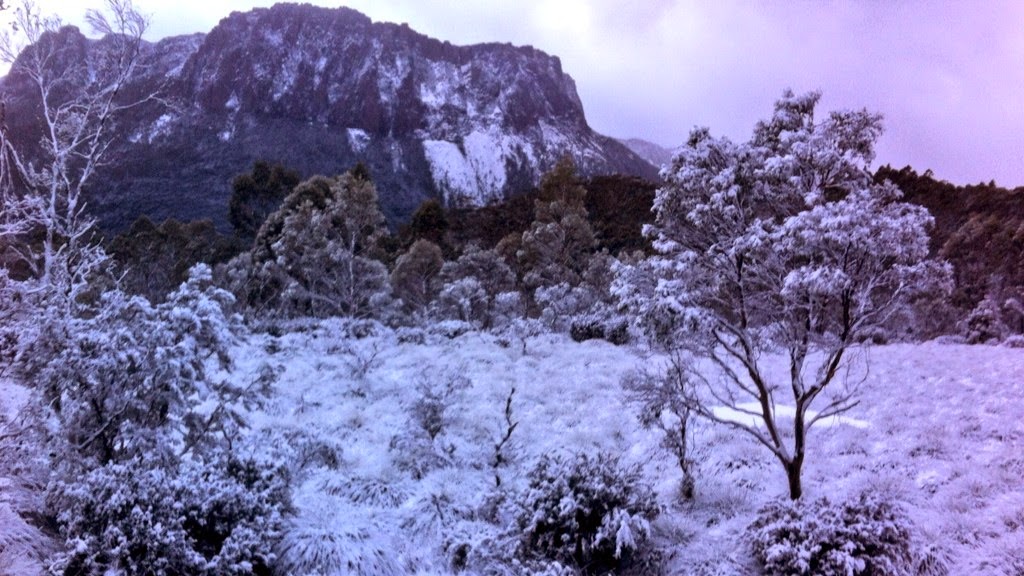
View from Cradle Mountain Hut of Cathedral Mountain after heavy snowfall.

For the first time ever, Cradle Mountain Huts decided to trial a winter experience this year. Allowing an extra night (so now six nights), it wanted to see if guests were keen to see this gorgeous part of the world when it is at its coldest. And stunning it was. The rivers were thundering, the snow was thick and soft and deep in places, and the forests with snow in them were a fairy land. I can't show you many photos, because my story in OUTBACK magazine is still to come out (keep an eye out for the Oct/Nov issue), but sufficient to say it is probably the most beautiful long-distance bushwalk I have ever been on. We had wind that knocked us over, rain that soaked us, and snow that filled our packs, but it was worth it.
Top of Pelion East in winter.

This is not a walk for non-walkers. Some days were taxing, and because there is no other access to the huts, you need to carry a reasonable load (at least 15kg), including snow shoes, crampons and emergency sleeping gear. But at the end of each day, you get to the secluded and private Cradle Mountains Hut, to have hot showers, a glass or two of wine, and a delicious and nutritious hot meal cooked by your guides. There is certainly no degustation menu, but the food is plentiful and surprisingly good, with three or four courses every night. The huts are welcoming, but it is not five-star. The bedrooms were iceboxes, and you need the warm sleeping bags provided.

Overall, the experiences couldn't really be more different: one is perfect for casual walkers who want a different experience and to enjoy some top-class food and accommodation; the other is an incredible walking experience, with the comfort and safety of guides and huts, but in the wilds of a Tasmanian winter and whatever it decides to dish out.
Or to put it another way, one is perfect for my wife, the other perfect for me.

See you on the track
www.kensbigbackyard.com.au

Saturday, 2 August 2014

How outdoor shops are stopping people going outdoors

Outdoor shops stopping people going outdoors

Our capitalistic, narcissistic obsession with "stuff" is making it too expensive and too damn hard to go bush.

An amazing camping experience, without all the latest "essential" gear: North West Island, Queensland.


Back in the Middle Ages, when I was studying at the University of Technology, Sydney, advertising 101 included the basic aim of advertising in a capitalist economy: to sell people stuff they don't need. It's pretty simple really – if people actually need things, they either have them already, or know how and where to get them (and are simply prevented by circumstances such as finances). So advertising's only purpose is to convince people that they actually need more than they currently have, in order that they will buy stuff and keep this strange, environment-destroying economy going. Economic growth is purported to be the ultimate good, and the sign of a "strong" politically adept society, as opposed to a malfunctioning catastrophe that is continuing to plunder resources to create things we don't actually need.
Been to an outdoor/camping shop lately? Seen the extraordinary range of goods on offer? I'm talking about Kathmandu, Mountain Designs, Paddy Pallin, etc, etc. The range is bewildering at best, and the prices, in many cases, extraordinary.
My elder sister (now the high side of 50) received a Duke of Edinburgh award when she was at school. She had a simple, two-pole A-frame hike tent that I was still using 20 years later, a fairly crappy, heavy sleeping bag, and a rough, framed pack. My folks weren't rich, but could afford all of that, and encouraged her to go, despite her tiny size and lack of experience.
Today, I hear of parents not allowing their kids to do the excellent Duke of Edinburgh program, because it simply costs too much. By the time the kids buy all the gear, and pay for the increasingly heinous and compulsory costs for the school to employ an outside company to run the program (in most cases now, it's not considered acceptable for a teacher with great camping/hiking experience to run the course), the cost can be well over $1000. This is just for kids to get out in the bush and go for a walk for a couple of days. I think it is obscene.
My encouragement in my book, Top Walks in NSW, and in fact whenever I get the chance, is to just get out in the bush with a few simple things, and down the track work out if you'd like to upgrade something.
Start simple, and add things as you feel you need them.

If you are not doing something extreme (such as off-track camping in the high country in winter), and take a few simple precautions, you really don't need a lot of "stuff" and you don't need to spend hideous amounts of money, despite what the outdoor shops will tell you. Yes, you need something on your feet. If the track you're planning isn't particularly stony, try your sneakers if you have nothing better. Heck, the old Dunlop Volleys was used to set some of the most classic rock climbs in the Blue Mountains.
Yes, you need a pack to carry stuff in, but I wouldn't recommend spending hundreds of dollars until you know what you want. My wife just bought a $40, 65-litre pack from Aldi for my son. I loaded it up with some heavy weights and took it for a field test . It has pockets in the right places, a rain cover, padded hip straps, and certainly on a three-hour walk was as comfy as my $250 pack. I don't expect it to last as long, or to be as good in all conditions, but heck, maybe that's all you need. And why spend $250 or more on a pack if you use it once every two years?
A $40, 65-litre Aldi backpack. No worries.

You will need a raincoat, but I find little difference between $70 raincoats and $300 raincoats. I get slightly damp (but not wet) in both. You will need something to cook on, and something to sleep in, but you may not need to get the most recent ultra-light, Himalayan standard sleeping bag if you are just going car camping a couple of times a year. In fact, if that's the case you may not even need a bag at all - often a doona and sheets will be more comfortable anyway.
Some of the staff in outdoor stores are incredibly knowledgeable and keen hikers/climbers/canyoners/campers themselves. Their advice can be invaluable. But just don't get sucked in to thinking that you need the latest and greatest thing in order to get out in the bush. You don't.
I'm about to hit the Overland Track mid-winter, during a predicted fierce cold snap, with snow down to 200m. I'll be interested to see how my conglomeration of assorted gear from various previous outdoor sports over the years (skiing, canyoning, hiking etc) stands up to the challenge. The only thing I bought new was $40 gaiters, as I've never previously had the need to buy them, although I did once borrow a friend's pair of gaiters for hiking through spinifex in the Kimberley.

Hope to see you out there sometime.
www.kensbigbackyard.com.au

Saturday, 19 July 2014

Red Hands Cave walk

Red Hands Cave walk

One of the closest Blue Mountains walks to Sydney is a cultural spectacle through a bird-filled valley.

Red Hands Cave, showing hand prints and hand stencils in different ochres.

I've mentioned before that one of the difficulties for those of us who bushwalk regularly is that we have  favourite walks and favourite areas to walk, and it can become hard to make the time to try other areas. When I do get a half or full day to go hiking, I want to go somewhere that I know I'll love, rather than just somewhere ho-hum.
As a result, when I'm driving up the Blue Mountains from Sydney, I nearly always drive past the Glenbrook entrance to Blue Mountains National Park, which holds just about the closest Blue Mountains walks to Sydney. In fact on a Sunday morn, it's less than an hour's drive from my place in suburban Ryde. You basically drive up the steep escarpment and Glenbrook is the first little village. The only times I've really hung around this area are because it's the end of the legendary Oaks Fire Trail mountain bike ride, or because of the extensive camping and picnicking areas at Euroka Clearing, where wallabies and kangaroos are fairly easily spotted at dusk.
Many times I've driven past, knowing that a walk I would do "one day" would be the little walk to Red Hands Cave, an Aboriginal site. I've seen lots of handprints and hand stencils on walls before, so I guess it hasn't been high on my priority list.
But today I finally got there, and it's a little gem of a walk. If you start down at the delightful Jellybean Pool (perfect for a swim in summer) it's basically a P shape walk, with a loop at the far end. It weighs in at about 8km, and 11-year-old legs today did it in an easygoing 3 hours, with a few breaks.

Start

You can park at the top ranger station, or I think it's better to drive to the Jellybean Pool carpark (in summer this might be crowded). Wander down the stairs to the pool, then turn sharply right and scramble up and over track along the creek to the right. After about 5 minutes, you'll hit the road. Cross the causeway, then turn right along the marked track.
Across the causeway, Blue Mountains National Park, Glenbrook.

This takes you up a lovely bird-filled valley. Without trying, we saw whipbirds, gang-gang cockatoos, king parrots, golden whistlers and fairy wrens. There are some lovely large overhangs to check out and some gorgeous mixed trees in the forest, including the pink smooth-barked apples. A bit over half an hour of walking will bring you to the loop track.
Red Hands Cave Walking Track.

Red Hands Cave

I think the loop is best done anti-clockwise (because of the steep stairs on the loop track), so continue straight ahead, and the walk gradually climbs up the valley. Then all of a sudden you'll be at the sensational Red Hands Cave. Unlike many sites, it has both hand stencils (outlines of hands) and hand prints, and the dozens of images are starkly clear. It of course has a large mesh barrier around it, but even that doesn't take away from the magnificence of this site. Handprints have been estimated at up to 1600 years old, and there are a few other drawings too. On the floor of the cave you can clearly see the ochre grinding grooves, some stone tools, and a pile of red ochre.

The loop 

Once you've enjoyed this special spot, continue up the path, and in about 10 minutes you'll hit the car park and picnic area, which has a pit toilet. A track leads from the picnic area (not marked), which is the loop track. It seemingly heads off in the wrong direction for a while, but does make it back, via a different, lovely valley. Half an hour's walk down this track will take you to a small rock clearing on the creek on the left hand side. Stop here, as it has some very well defined and picturesque axe-grinding grooves. Stay for a while and see what else you notice, as there are other less-defined features. It's a good spot for a break.
Clearly defined grinding grooves and other features.

Back for a swim

The main track continues about another 5-10 minutes before it rejoins the original track, and you simply turn right, and follow it back to Jellybean Pool and that waiting swim. It's pretty brisk in winter, so you can almost guarantee you'll have it to yourself.
Overall, it's a corker of a little walk, and I really felt privileged to see two such well-preserved Indigenous sites so close to Sydney.
www.kensbigbackyard.com.au

Saturday, 12 July 2014

Best bushwalks in each state in Australia

Best bushwalks in each state in Australia

Well, here are my personal favourites anyway. Would love to hear about yours!


This time of year remains one of the best times to get out and about, and our country has such a wealth of wonderful tracks on which to lose yourself for a couple of hours, or a couple of days. I've been blessed to have walked in every state in the country, and although there are still many, many more tracks to explore, here are my current favourites. (Although the great thing about any list of 'favourites' is that it can change.)

ACT

With everything from snow-capped mountains covered in alpine vegetation, to wetlands, the ACT has a lot to offer the keen bushwalker. My favourite walk though is a fun little gem, found in my book Top Walks in NSW. It's called Square Rock, and finishes with a short climb up a ladder to an extraordinary 3D rock playground on the edge of a precipice. Views, wildlife and a bit of an adventure - all in a few hours. 9km return. Definitely recommended.
Square Rock, ACT


NSW

Admittedly I've done much more walking in my home state than any other, and so I have a much wider choice. My top 63 walks are in Top Walks in NSW. But my absolute favourite walk in the state remains the century-old National Pass. With dramatic cliffs, sensational views, plunging waterfalls, rainforest and NSW's only endemic bird species, it's a brilliant walk at any time of year, and in any weather. Allow half a day for the steep 6km loop.
The wonderfully precipitous path on the National Pass, Blue Mountains.


NT

So many great walks to choose from, from desert country to tropics, and my pick of the bunch is a little walk that few do. I haven't done it for a few years now, so I hope it is still as good, but my memories of doing it with my parents, a child in a backpack on my back, and a pregnant wife, are very vivid. It's called Chain of Ponds, is a 3.5km loop, and is in Trephina GorgeNature Park. Trephina Gorge itself is worth wandering up too - all within the less-visited East MacDonnell Ranges.

QLD

A couple of weeks ago I returned from the only "great walk" in Queensland, the new four-day Scenic Rim Trail. I do love those highlands in the south-east part of Queensland, and my favourite walk is actually on the other end of the Scenic Rim, in Lamington National Park. It's the 17km Tooloona Creek circuit, leaving from O'Reilly's, or the walk through to Binna Burra,  via Tooloona Creek rather than just the Border Track. There are Antarctic beech trees, gorgeous rainforest, and birds galore. A solid day out for those not used to walking, but a joy nonetheless.

SA

I must admit my walking experiences in SA are limited, and I am still hoping to get to that bushwalking mecca of the Flinders Ranges. I've had some great experiences though on Kangaroo Island. But my favourite walk is way up in the north-east corner of the state, along Cullyamurra Waterhole near Innamincka. Wonderful outback scenery, birds such as brolgas and the sad history of Burke and Wills. At the top of the waterhole are some extensive Aboriginal engravings. Camp along the waterhole and just explore as far as you want.

TAS

Oh, again, so, many walks from which to choose, and I've been blessed to have experienced so many. Cradle-Mountain-Lake St Clair National Park is a favourite area to hike (how good are the Twisted Lakes?), as is Mount Field National Park. One of the most popular tourist sites in the country is the Tahune Airwalk on the Huon River, a raised platform walk on forestry land, 90 minutes drive south of Hobart. Just near it, however, is Hartz Mountains National Park, an untamed sub-alpine wilderness, with swirling winds, changing moods, and, if you hit it on the right day, some of the best views over Tasmania's south-west forests. Few people go here, and you will need to be well prepared, but the five-hour walk up Hartz Peak is an absolute cracker.

The track less-travelled: Hartz Mountains National Park, Tas.


VIC

From alpine areas to wild coastline and wonderful koala-filled forests along the Great Ocean Walk, as well as one of my favourite national parks in the country, the Grampians, Victoria has been known for many years as the best state for bushwalking in the country. My favourite walk is the multi-day 35km  loop to Sealers Cove and Refuge Cove in Wilsons Promontory National Park. Gorgeous remote beaches, wildlife including wombats, and some of the nicest coastal scenery in the country. It's no wonder this is such a popular national park for Victorians.

WA

Again, what a wealth of riches in this vast state, from the subalpine peaks of the Stirling Range National Park (again, one of my favourite national parks in the country), to the towering karri, marri and jarrah forests, to the floral bonanza of Fitzgerald River National Park. But I'm going to jump to a walk way up in the Kimberley, in Purnululu National Park. The multi-day walk up Piccaninny Creek, past one of the most beautiful and iconic landforms in Australia - the extraordinary Bungle Bungles - this walk will probably see you wading through waterholes, avoiding wildlife such as snakes, and dodging prickly spinifex. It's the only gorge within the park that you are allowed to explore, and I've met people up there camping for nine days. But even a hike one day in, then setting up a camp and exploring from there, will see you deeply immersed in one of the most spectacular parts of the country.

As always, I'm keen to hear from others - particularly so I can keep a lookout for my next walks.
www.kensbigbackyard.com.au      

Sunday, 6 July 2014

We need higher taxes

We need higher taxes

Yeah, that's right. Charge me more for being an Aussie worker.

Go on. Tax me harder.

At this time of the financial year, when we dread getting out the magic shoebox of receipts and wading through spreadsheets in order to come up with paying the least tax we can get away with, I want to sit back and reflect about a few things.

Today we had the "bust the budget" marches across Sydney, Melbourne and elsewhere complaining (quite rightfully) about the current financial slashing of a whole host of things that were previously considered important in this country: the environment, science, the arts, conservation, tertiary education, health, elderly care, foreign aid ... to name a few.
Now, like everyone, if I was in power, I would prefer to see financial slashing of other parts of the budget. For example, defence always seems to get a big swag of cash that is sacrosanct. But I am not making those decisions, and don't know all the pre-existing agreements and ins and outs of dropping spending on something, just because it isn't the bees knees in my way of thinking. Yes, I would make different decisions, but so would everyone.
So, in the light of that, it becomes increasingly clear that our governments just need more cash. I want government to spend money on protecting biodiversity. I want it to fulfil its international obligations on asylum seekers, on foreign aid, on creating new protected areas. I want it to properly fund our health,  education and science sectors, so that we can again be world-leading innovators and changers. I want a thriving arts community. I want a public transport system that works well, and is integrated, and forward thinking. I want more development of green power and farming methods that will see us prosper and look after our land for unlimited generations to come.
Politicians of any political persuasion won't pitch as their election promise "I promise to raise taxes" – hardly slides down the throat with a nice shiraz. But perhaps my little voice can be added to a few others to say, "hey, tax us a little more, and then deliver us what we really want".

www.kensbigbackyard.com

Saturday, 21 June 2014

Easy rock climbs around Sydney

Easy rock climbs around Sydney

Some recommended outdoor rock climbs for beginners or those with creaky knees

Ken Eastwood feeling "Hope" (grade 15), Mt Piddington.

I get such a buzz out of rock-climbing. Particularly lead-climbing. There are very few other moments in life when I am completely "in the moment", focused totally on every move, on every dimple in the rock, on the kiss of the sun on my skin or the breeze at my back.
I also love sharing the joy of rock-climbing, and end up taking out a lot of people new to the sport, or those who want to get out of the climbing gym and try the outdoors.
I suspect there are many people in and around Sydney who have struggled, as I have, to find great areas to take beginners. Also, the reality is that as approach a half century, and don't spend nearly enough time on rock, that I will increasingly need to find easier spots to climb myself.
Unlike some other cities, we don't have that many superb, easy places to climb. Brisbane is so well set up with Kangaroo Point. It's lit up at night, so you can climb in the evenings, and has excellent fixed protection at the top so it is easy to set up top ropes.
After almost 20 years of outdoor climbing, I reckon good areas for beginners (or those who want an easy day out at the rock) have reasonably easy top-rope set ups, aren't overly steep (not past the vertical), and have at least some holds with big, chunky holds, so that everyone can get up at least one climb. These are surprisingly hard to come by.
Once climbers have experience, particularly in lead-climbing with a natural protection rack, the Blue Mountains becomes an obvious choice, because there are just so many climbs up there, and hundreds upon hundreds at easier grades – some of which are superb adventures. Heck, the very first climb in the brilliant guidebook Blue Mountains Climbing is a superb four-star, 150m epic called Tom Thumb, at a very achievable grade 13. However, I think it is ridiculous to think that beginners with no experience would or should attempt that. Some time needs to be spent learning a few techniques and moves, and getting comfortable on rock first.
So, the following isn't by any means an extensive list (and favours the north side), but it shows some of the spots I have enjoyed fairly stress-free times out at a cliff. Please let me know your faves too, and I hope to see you out there sometime.

Lindfield Rocks

A classic bouldering area (meaning an area usually climbed without ropes), this can work quite well for beginners, particularly kids. It's relatively easy to set up top ropes, and if you choose your climbs carefully, most beginners should be able to get up a couple of routes. One of the problems with it as a bouldering area, is that it is high enough to be quite dangerous if you fall, and some of the landings are awful. However, it isn't really high enough for most climbers to be on rope (climbs are only about 6-8m long at best), but certainly works as a beginners spot. (Park at tennis courts at Lindfield Oval, and take the walking track for about 5 mins.)

Barrenjoey

The stupendous view over the isthmus, halfway up a climb at Barrenjoey.

Probably not for absolute beginners, but this is such an absolutely classic, gorgeous spot that it is definitely worth the drive up to Palm Beach. Hike along the bayside beach then bash along the bush for a few minutes and up to the cliffs. One of the best areas for beginners is the first area you come to on the south-west side, and you can spend a fun day poking around on climbs such as Millie, Carrie Bradshaw, Starboard Barnacles, Professor Wigginsworth's Chunder Bucket and Crack of Dawn. The views back along the isthmus are glorious. It will greatly help if someone in the group is confident leading sport climbs at grade 14, in order to get to the top. Afterwards, you get to swim at one of Sydney's best beaches, and can even do some easy and fun bouldering on the sand at the big boulders half way along the beach. 

Berowra

A little higher than the previous two spots, this can be a bit of a struggle for beginners, as grade 16 or 17 is often too hard for them. But there are lots and lots of climbs, you can set up top ropes fairly easily and if people are willing to have a go, you can still have a great day out here. It's also lovely and warm on winter arvos! Kenneth's climb (no, not named after me unfortunately, but after a lovely skink that used to live in the crack) is a challenging grade 14. Drive to the end of Wideview Road in Berowra, head left to the cliff and don't fall off.

The Stables

Hidden up in Pennant Hills, this is a surprisingly good little area in some lovely forest. Good for summer, as it's quite shady and protected. Best recommendations are getting to Storm Wall and doing climbs such as Clipz, Yoink, and Carrots are Vegetables if you're up to some jamming. Find it at the end of Schofield Parade, Pennant Hills and then follow the instructions in the online guide.

Suicide slabs (now called Brooklyn)

A bit of a run-out lead, so take care, but this big slab is in a glorious spot beside the boat ramp at Brooklyn. Exhibitionists will like it, as you usually get a bit of an audience. There's a two-star grade 15, and a couple of 14s, but easy to slide across and try a couple of slightly harder ones on top rope.

The Block, Medlow Bath

If you're up to heading into the Blue Mountains, it can be difficult to know where to start. So many gorgeous areas and climbs. This is a wonderful little spot, and if you study the guidebook and wander around a bit, you can find a host of climbs here. One of my regular climbing partners did her first lead climb here, a 22m long ripper called Manana, with a difficult finish. It's just around the corner from The Block, which has a mix of roots including the very nice line of Ole Biscuit Barrel (grade 14).

Mount Piddington, Mt Victoria

Top of Mt Piddington - glorious views.
With more than 200 routes here, there is plenty to keep you occupied at virtually any level of climbing. The bulk of it requires natural protection though, so not so great for those without access to a natural protection rig (placing cams, nuts, hexes and wires to protect you from a fall, rather than relying on pre-drilled bolts placed by someone else). Still, it's probably one of the best places around Sydney to learn to lead on a natural protection, because there are so many lower-grade climbs. The great unwashed, at Grade 10, is a fun, unusual climb with a great mix of moves. I had a bit of an epic recently on Chicken Hearted (grade 13), and have enjoyed playing on climbs such as Faith (an excellent three-star grade 8 with the ability to set up top ropes on chains to tackle some of the surrounding climbs), Hope, Chastity and Sincerity. Always scope here to take a break and admire the climbers attacking harder leads such as the five-star classic The Eternity (grade 18).

Please remember that climbing, like all outdoor sports, has inherent risks, and if you do not know what you are doing, you should join a club, befriend someone experienced, or pay for some training. Having said that, I maintain that statistically you are far more likely to get injured or killed driving or cycling to a climbing site or crossing the road than you are actually at the site.

Do you have other recommended areas that are great for beginners in and around Sydney? Please let me know!
www.kensbigbackyard.com.au